
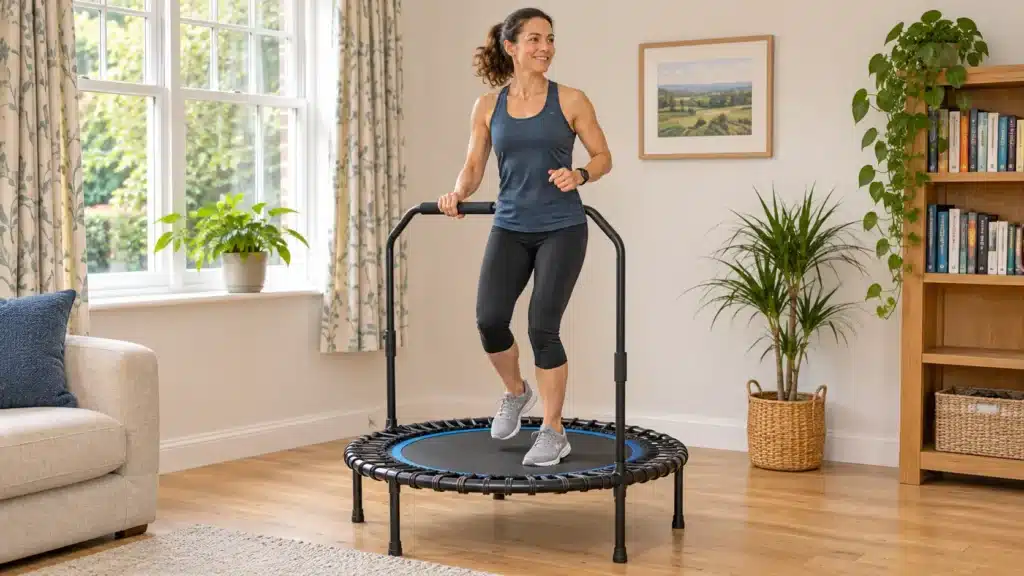
Woman using a mini fitness rebounder with a stability bar in a bright living room

Workout Trampoline with Bar: Setup, Safety & Beginner Moves

UK REBOUNDER PRACTICAL GUIDE

A workout trampoline with a bar is a fitness rebounder fitted with a handle designed to help you steady yourself during low, controlled movements. The bar does not make every jumping exercise safe, and it is not necessarily designed to support your full body weight.

Start here: check that the manufacturer approves the bar for your exact rebounder model; follow the attachment instructions; leave clearance all around the frame; and begin with small movements while standing centrally. If you are still choosing the equipment, see our UK adult rebounder buying guide.

Affiliate disclosure: Some linked buying and offers pages use affiliate tracking. We may earn a commission if you purchase through an eligible link, without extra cost to you. This article is general equipment guidance based on manufacturer instructions; it does not claim hands-on testing or provide medical advice.

THE BASICS

What does a stability bar actually do?

A compatible bar provides a handhold that may help an adult maintain confidence while stepping, balancing or doing a small controlled bounce. It can be especially useful while you get used to the size of the mat and the movement of the frame. The correct exercise remains low and controlled; the handle is not a reason to add high jumps, twists or heavily loaded strength movements.

Important: manufacturer limits are model-specific. Rebound Fitness describes its bar as an aid for balance and advises users not to hang on it or rely on it to carry their weight. For other brands, check the relevant manual instead of assuming the same attachments or load rating.

BEFORE YOU BUY

Choose a bar that fits the rebounder

Not every mini trampoline has the same frame diameter, attachment points, geometry or approved accessories. A bar that appears similar in a photograph may not fit your unit securely. Before ordering a bar separately, confirm its model compatibility in the manufacturer’s instructions or accessories listing.
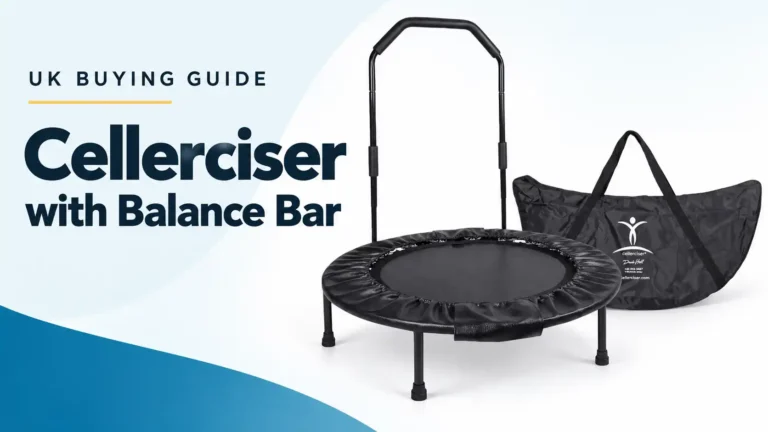
Cellerciser fitness rebounder shown with an attached Streamline balance bar and carrying bag
Illustrative example: Cellerciser with a balance bar. This is not one of the three Rebound Fitness bundles compared in our buying guide; attachments differ by brand and model.

T-Bar

Typically offers a central grip. Check how it attaches, its height range and whether it can be removed for storage. Do not assume it is meant for leaning or vigorous jumps.

U-Bar

Offers a different grip shape. Its wider form may change where you place your hands; check clearances, adjustment and intended exercises on the exact product.

Bundled or optional?

Some rebounders include a stability bar; others offer it separately. Check the full product configuration and whether a bar obstructs the intended folding mechanism.

For example, the Rebound Fitness UK catalogue lists distinct Fit Bounce Pro II U-Bar and Maximus Pro Bungee T-Bar configurations. The manufacturer also warns that its separate bungee stability bar is specific to listed models, not universally interchangeable. Check the current listing before purchase.

PRE-FLIGHT CHECK

Five checks before stepping on

  1. Choose an appropriate location. Set the rebounder on a level, stable surface with free space around it and overhead. Keep it clear of furniture, radiators, doors and light fittings.
  2. Inspect the equipment. Check that the legs, frame, mat and suspension are secure and free from damage or unusual wear. Do not use damaged equipment.
  3. Fit the bar as instructed. Use the supplied hardware and the manufacturer’s sequence. Confirm each attachment is secure, with no unexpected movement; do not improvise fixings.
  4. Check its intended use. Follow the maker’s limit for the bar, the rebounder and any included accessories. A weight rating for the trampoline does not establish how much load the handle can take.
  5. Choose suitable footwear. Follow the specific rebounder manual. Metal-spring and bungee models may have different footwear guidance; avoid unsuitable loose footwear or anything that could catch.

BEGINNER MOVEMENTS

A controlled first session on a rebounder with a bar

These examples are not a medical or rehabilitation programme. Only try a movement if you are comfortable standing on the equipment, the manufacturer’s manual allows it and you can remain in control. Start with very small movements; no set duration is mandatory.

01

Settle your stance

Step onto the centre while the mat is still. Keep your knees relaxed and your posture upright. Use a light handhold if the bar is intended for that purpose.

02

Shift weight gently

Without jumping, transfer weight between feet in small, comfortable amounts. Check that the frame stays stable and your feet remain well within the mat.

03

Try a small downward press

Let the mat move beneath you while keeping your feet close to, or in contact with, the surface. You do not need to reach a visible jumping height.

04

Progress to easy stepping

If you feel steady, try gentle marching in place. Stop or step back to simpler movements if you need to pull on the bar, feel dizzy or lose control.

Avoid tuck jumps, high twists, unsupported one-foot movements and exercises that require you to lean heavily on the bar. For general activity targets, refer to NHS physical activity guidance; a mini-trampoline routine is only one way to build regular movement.

Common mistakes to avoid

  • Treating a stability bar like a handrail: Unless the maker explicitly permits it, do not hang, swing or support your full weight through the handle.
  • Using an unapproved attachment: An accessory from another brand may attach poorly and should not be assumed compatible.
  • Choosing by outside diameter alone: the usable mat is smaller than the full frame; measure the actual space available for your feet.
  • Ignoring the bar during storage: check whether it must be removed before folding legs or a hinged frame.
  • Assuming health results: using a bar does not guarantee joint protection, injury recovery, weight loss or a given calorie burn.

BUYING NEXT STEPS

How to choose a suitable bar-equipped rebounder

Start with the type of frame and bounce system that fits your home; then decide whether you need a T-Bar, a U-Bar or no bar at all. A bar-equipped model is not automatically superior to a well-chosen rebounder without one.

For model comparisons and bundled accessories: use our UK exercise trampoline with bar buying comparison. For broader spring-versus-bungee, storage and adult fitness decisions, return to the general adult rebounder guide. If buying from Rebound Fitness, check current UK offer terms and exclusions rather than assuming a code is valid on every bar bundle.

QUESTIONS

Stability bar FAQs

Does a bar prevent falls?

No. It provides a potential point of balance support, not a guarantee. Movement, flooring, fitting, the person’s balance and the design of the equipment still matter.

Can I add a bar after buying the rebounder?

Only if the manufacturer offers a suitable accessory for the exact model and the fitting method is approved. Check before ordering.

Is a T-Bar better than a U-Bar?

Not universally. The choice depends on fit, height adjustment, hand position and the exercises approved by the manufacturer. The shape alone does not establish medical or safety benefits.

Can I use a bar after an injury?

Do not treat the bar as a replacement for assessment or prescribed rehabilitation. If you are recovering from an injury or have significant balance difficulties, seek individual professional guidance before using a rebounder.

THE TAKEAWAY

A light handhold can help; good set-up matters more

Choose a compatible bar, assemble it as instructed and practise controlled movements. If you find you must lean heavily, lower the intensity or stop. When selecting a product, prioritise compatibility, room clearance, frame stability and storage rather than a list of unsupported health claims.

Compare bar-equipped rebounders for UK buyers

Sources: Rebound Fitness model-specific bar compatibility; manufacturer Fit Bounce Pro II U-Bar and Maximus Pro Bungee T-Bar listings; NHS adult activity guidance. Sources were reviewed in November 2026. This guide does not claim personal product testing or clinical evaluation.

How useful was this post?

Click on a star to rate it!

Average rating 0 / 5. Vote count: 0

No votes so far! Be the first to rate this post.

We are sorry that this post was not useful for you!

Let us improve this post!

Tell us how we can improve this post?

Leave a Comment

Your email address will not be published. Required fields are marked *

Scroll to Top